

There are certain sights in the capital everyone should know, so we’ve gathered them in one article. It’s a handy guide if you’re hosting relatives from other parts of Hungary or friends from abroad and aren’t sure what to show them in Budapest — and it’s just as useful for those moments when you want to see the city through tourist eyes.
Városliget / City Park

City Park (Városliget — once nicknamed “Lizsé”) is one of the world’s earliest public parks, a pleasure to stroll in every season, and a place locals should rediscover from time to time, not just tourists. Spreading over roughly 120 hectares, it offers everything a city-dweller could want: shady trees, a rose garden, a lake that turns into an ice rink in winter, a botanical garden, sports facilities, and a handful of striking buildings (hopefully not many more in future). Don’t miss Vajdahunyad Castle and the beautifully restored Millennium House, as well as bold contemporary landmarks like the Museum of Ethnography and the House of Music Hungary. Lovers of heights can also try the BallonFly tethered balloon, which rises to 150 metres for sweeping views of Budapest.
Andrássy út

Undoubtedly Budapest’s most beautiful and intriguing boulevard, Andrássy Avenue charms with its grand palaces and double row of trees. It’s a walk worth taking not only as a visitor but as a local too — you can easily spend hours admiring the architecture (and the luxury shop windows). Nicknamed the Hungarian Champs-Élysées, it was laid out for the 1896 Millennium, linking the main celebration sites — Heroes’ Square and City Park — with the city centre. The capital’s widest avenue, it has the Millennium Underground (M1) running beneath it, and landmarks such as the Opera House, the Art Nouveau Párisi Nagy Áruház, the House of Terror, and the Hungarian University of Fine Arts along its route. From Erzsébet tér to Oktogon you’ll find flagship stores of world-famous luxury brands; from Oktogon to Kodály körönd the avenue widens with two service roads and tree-lined promenades; between Kodály körönd and Bajza utca the palaces sit back behind front gardens, and from there to Heroes’ Square the scene shifts to freestanding villas with gardens.
New York Café

The New York Palace’s lavish interior—awash with mirrors, gold and marble—is one of the city’s most iconic sights, and it’s common to see long queues outside even in pouring rain. Built as the headquarters of a New York insurance company, the café inside became the centre of literary life in the early 1900s, home to the regular tables of Nyugat and Pesti Napló. Writers such as Dezső Kosztolányi, Sándor Bródy, Mihály Babits, Margit Kaffka and Sándor Márai all passed through here, and—so the (untrue) legend goes—Ferenc Molnár once tossed the key into the Danube so the place would never close.
Following years of decline, it closed in 1990, then was reborn after a thorough restoration in 2006. Restored to glory, the New York Café has twice earned the title of the world’s most beautiful café, with live Roma music performed several times a day.
Dohány Street Synagogue

Dohány Street Synagogue — Say “synagogue” in Budapest and this is likely the one that comes to mind. Completed in 1859 and seating around 3,000 worshippers, its twin towers and Moorish-Revival details make it both a landmark of Hungarian Jewry and a city icon. As Pest’s Jewish community grew in the 19th century, the congregation set out to build a synagogue of scale and beauty. In 1850 they invited designs from several architects — József Hild, Frigyes Feszl and József Kauser among them — before commissioning Ludwig Förster, designer of Vienna’s synagogue. The result is the two-towered, Moorish-inspired monument we see today: the largest synagogue in Europe.
A Szimpla Kert

Although there are far fewer of them today than back in the 2000s, these quirky bars still draw in the crowds – especially international visitors. Most ruin pubs were born in abandoned apartment buildings that had fallen into disrepair and were earmarked for demolition. Thanks to local residents, many of these buildings were granted protected status. Since demolition was no longer possible and renovation required a lengthy approval process, developers chose to rent them out instead – and so Budapest’s ruin pubs were born.
The legendary Szimpla Kert is one of the oldest, most complex and best-known of them all. Here, you’ll find something happening every single day of the week, from live concerts and parties to art exhibitions and even a flea market. This wonderfully eclectic world is something we think everyone visiting Budapest should experience at least once.
Parliament

Designed by Imre Steindl, the Hungarian Parliament Building is one of Budapest’s most photographed and most beloved landmarks. It took 20 years to complete the colossal structure, which stretches 268 metres in length, 123 metres in width and rises 96 metres high. To decorate it, builders used 40 kilograms of gold and half a million ornamental stones – not to mention the 40 million bricks that form its foundations.
Even before it was finished, the Parliament sparked heated debates, and over the years, it has witnessed its fair share of drama within its walls – including one notorious occasion when the debating chamber itself was damaged.
St Stephen’s Basilica

St Stephen’s Basilica is the largest church in Budapest, a grand neoclassical landmark where you’ll almost always spot tourists sitting on its steps or gazing up in awe from the square out front. Its construction spanned half a century, during which the dome collapsed and three of Hungary’s most celebrated architects – József Hild, Miklós Ybl and József Kauser – left their mark on the building, along with some of the era’s finest artists, such as Károly Lotz, Miksa Róth, Mór Than, Bertalan Székely and Gyula Benczúr.
Step through the towering gates and you’ll find a sacred interior full of treasures – including the Holy Right Hand of St Stephen himself. With space for 8,000 people, the basilica welcomes visitors for quiet reflection or mass, free of charge.
Tram Line 2

Hop on Tram Line 2 and you’ll be treated to one of the most scenic routes in the city. As it rattles along the Danube embankment between Jászai Mari Square and Közvágóhíd, you can take in postcard-perfect views of the Chain Bridge, the Buda side with Gellért Hill, the Pest Promenade and Kossuth Square. Over the years, this riverside ride has even earned a spot among the world’s most beautiful tram lines.
Margaret Island

Margaret Island is a true paradise for anyone seeking outdoor fun. Nestled between Margaret Bridge and Árpád Bridge, the island is essentially a huge leafy park – an ideal spot for dates and downtime. Here you can stroll along the paths, admire the Danube and the riverside architecture, enjoy a picnic, splash about at the Palatinus Baths or swim laps at the Alfréd Hajós National Swimming Pool. You can also pedal around on a bringóhintó (four-wheel bike) or explore the island’s historic buildings, while sporty locals jog the 5.3-kilometre running track that circles the park.
Once you’re here, don’t miss the Japanese Garden, the small wildlife park, the musical fountain, the water tower and the atmospheric medieval monastery ruins. And if you’re in the mood for culture, check out the line-up at the Margaret Island Open-Air Stage.
Thermal Baths

Budapest is often called the “City of Baths” – and with good reason. Around 80 geothermal springs bubble up here, and not only the Turks but even the Romans built baths in the city. To this day, Budapest is the only capital in the world with its very own network of healing thermal waters. While the baths are prized for their medicinal, recreational and touristic value, they’re also worth a visit for the architecture alone. Many are heritage buildings, filled with intricate details, ornate decorations and aquatic-inspired motifs.
The most famous of them all is the Széchenyi Thermal Bath in City Park, the largest and most visited by tourists. The Gellért Thermal Bath, with its stunning art nouveau interiors, is another must-see. Other favourites include Rudas, Lukács, Veli Bej, Dandár and the Pesterzsébet Iodine-Salt Bath, while the historic Király and Rác Baths are currently awaiting renovation.
Buda Castle

No list of Budapest’s must-sees would be complete without Buda Castle and its surroundings. The palace on Szent György Square became a royal residence during the reign of Sigismund of Luxembourg, reaching its golden age under King Matthias and Vladislaus II. Although badly damaged when Buda was recaptured, parts of its medieval walls survived, and in the 19th century it was extensively remodelled to the designs of Miklós Ybl and Alajos Hauszmann. After the Second World War, the interior was not reconstructed, and today the palace houses the Hungarian National Gallery , the National Széchényi Library and the Budapest History Museum.
At present, large-scale restoration works are under way as part of the National Hauszmann Programme, which aims to return the palace and its neighbouring buildings to their former 19th-century glory. Beyond the palace itself, it’s well worth taking a long stroll around the Castle District – admire the sweeping views, wander among baroque townhouses, and don’t miss Matthias Church or the Fishermen’s Bastion.
Gellért hill
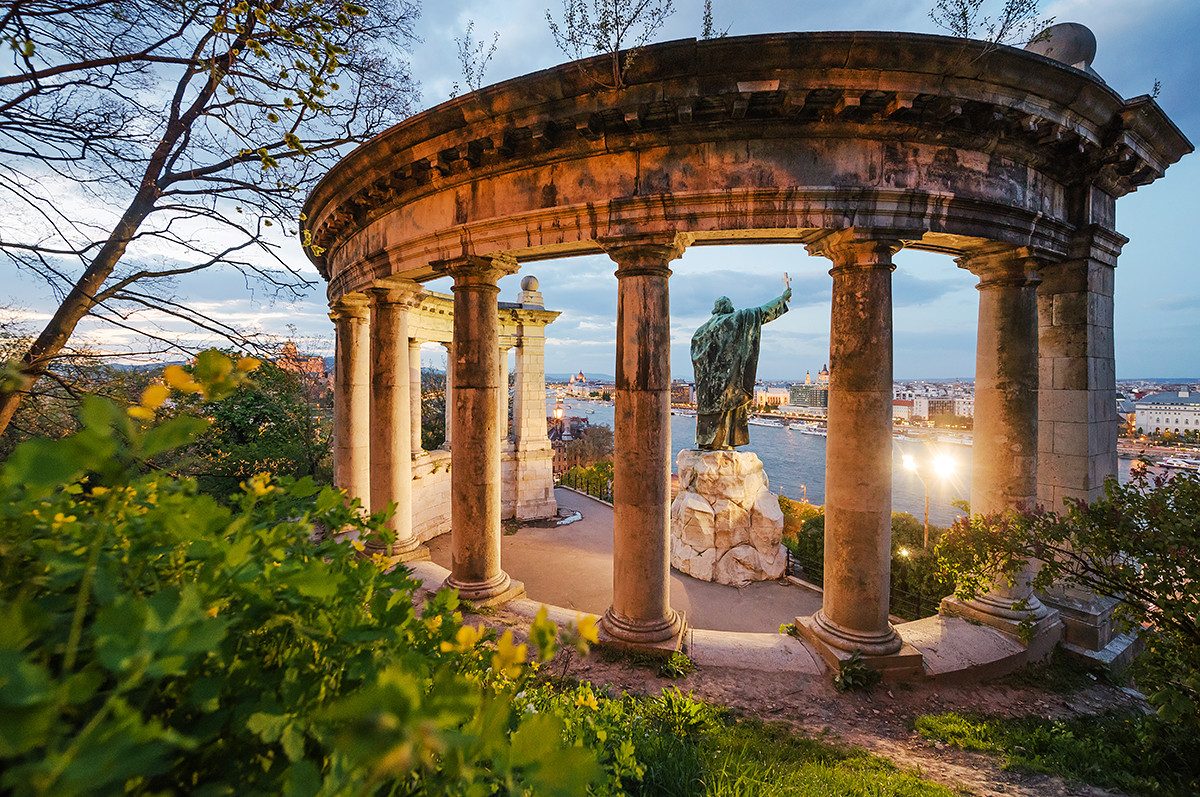
At just 235 metres, Gellért Hill doesn’t exactly rival the Himalayas, but tackling its steep paths can still feel like a workout. The reward is more than worth it: sweeping panoramas over the Danube, leafy trails with a touch of wilderness, and elegant villas peeking out here and there. Thanks to its central location and easy access, it’s one of the city’s most popular viewpoints.
Highlights include the Cave Church and the Citadel, while those looking for something quieter should head to the Garden of Philosophers, home to a statue depicting the meeting of Prince Buda and Princess Pest. There are two main ways up: from the Elisabeth Bridge, where in summer you’ll pass a cascading waterfall, or from beside the Gellért Baths, where a longer but gentler (and busier) route winds its way to the top.
Traditional Hungarian Food

Budapest is full of chequered-tablecloth eateries serving hearty, home-style Hungarian dishes – and not all of them are tourist traps. For a modern take on classics, A Kert Bistro brings traditional flavours into a lighter, bistro-style menu in a cosy, contemporary setting. Szaletly feels like stepping into an elegant turn-of-the-century villa, where refined Hungarian cuisine is paired with a warm, nostalgic atmosphere. If you’re after something truly old-school, Fekete Holló in the Castle District has been around for decades, serving generous portions of goulash, pörkölt and other comfort foods without the frills. Beyond these, plenty of neighbourhood favourites still capture the spirit of Hungarian home cooking – authentic, filling and made with love.
Central Market Hall

Opened in 1897, the Great Market Hall was the first of its kind in Hungary. Today, it caters more to tourists than to everyday Budapest shoppers, but you’ll still find plenty of fresh produce among the stalls. Back in the day, the rear of the hall even featured a poultry yard, filled with chickens and hens, so traders only had to walk a few steps to sell fresh eggs or meat. There was also once a tavern here, where hungry early-morning marketgoers could tuck into a hearty pörkölt at dawn.
Declared a historic monument in 1977, the building was beautifully restored in 1999, earning a prestigious international architecture award. Since then, it has become a permanent fixture in guidebooks and a must-see for visitors to Budapest.
Normafa

Normafa, set in the Buda Hills, is one of the capital’s favourite getaways – a place locals flock to in every season, whether it’s for the first snowfall, the first rays of spring sunshine or the colourful autumn forest. The area offers plenty of hiking trails and picnic spots, not to mention sweeping panoramas over the city.
According to legend, a mighty beech tree sprouted here in the year King Matthias was born, standing for centuries until opera singer Rozália Schodel performed an aria from Bellini’s Norma beneath its branches – giving the site its name. The tree was eventually struck by lightning in the 1920s and perished, but the spot remains a beloved excursion destination.
Getting here is easy: take buses 21 or 21A from Széll Kálmán Square, the Children’s Railway from Hűvösvölgy, or the cogwheel railway from Városmajor. Once at the top, don’t miss sampling the famous local strudel, and be sure to pop by the Normafa Ski House.
(Cover photo: Tamás Kőrösi – We Love Budapest)

Megjelent első bookazine-unk, ne maradj le róla!
Már 15 éve lélegzünk összhangban a fővárossal. Jubileumi kiadványunkban mindent megtalálsz, ami magazinunk és eddigi munkánk esszenciája. Gasztronómia, kultúra, városi legendák és Budapest arcai, interjúk, történetek és a legjobb helyek – úgy, ahogyan mi látjuk a fővárost.
Rendeld meg itt vagy keresd a nagyobb könyvesboltokban!
hirdetés


