

At first glance, the renewed Óhegy Cellar resembles a Mediterranean villa, with its yellow ceramic road, olive trees and carefully restored buildings. But the real surprise lies underground: during the guided tour, the sheer scale of the cellar spaces is breathtaking, each section revealing another layer of history. Set among panel blocks on Bebek Street, this world-class site feels almost unreal - a hidden treasure in the heart of Kőbánya.
Where centuries of history come together
The unique atmosphere of the Óhegy Cellar captivates even those who aren’t particularly interested in wine or winemaking. During guided tastings, visitors also gain insight into the past and present of both the wine cellar and the quarry - two histories that are inseparably intertwined. It’s an impressively layered story, stretching from centuries of stone mining all the way to winemaking.


Winemaking flourished in the area during the XVIII and XIX centuries, when vineyards covered the rolling hills almost as far as today’s airport. The limestone found here, however, was likely quarried as early as the Ottoman era, meaning that centuries truly shaped the site’s distinctive character.


The stone quarried here was used to build several iconic Budapest landmarks, including the Hungarian Academy of Sciences, parts of the villas along Andrássy Avenue, and even elements of the Parliament’s foundations and the city walls. Nearby Fehér út also preserves this history, as limestone was transported towards the city centre along this route, turning the road visibly white.


The towering stone walls - often reaching heights of 20 metres - are a real treat for geologists, revealing layers from different geological eras and fossils from the ancient Pannonian Sea. Winemakers also took advantage of the site’s natural conditions, such as stable temperature and ideal humidity, which made it perfect for wine storage.


According to surviving documents, a successful winery operated here even in the early 20th century, winning gold medals at contemporary competitions. The current owners also discovered an old postcard showing the building from the 1920s, when it belonged to the joint-stock company of Mór and Lipót Popper. At the time, the site functioned as a wine wholesaler, and the Popper family also lived in the building behind the quarry.

During the period of nationalisation, quantity replaced quality. Remnants of this era can still be seen in the enormous fibreglass tanks and the massive tiled cement reservoirs built in the 1910s, capable of storing tens of thousands of litres of wine, much of which was exported - including to the Soviet market. Thankfully, the current owners preserved these industrial relics. Alongside them, visitors encounter wooden barrels of various sizes and modern stainless-steel tanks throughout the roughly one-kilometre-long cellar system.

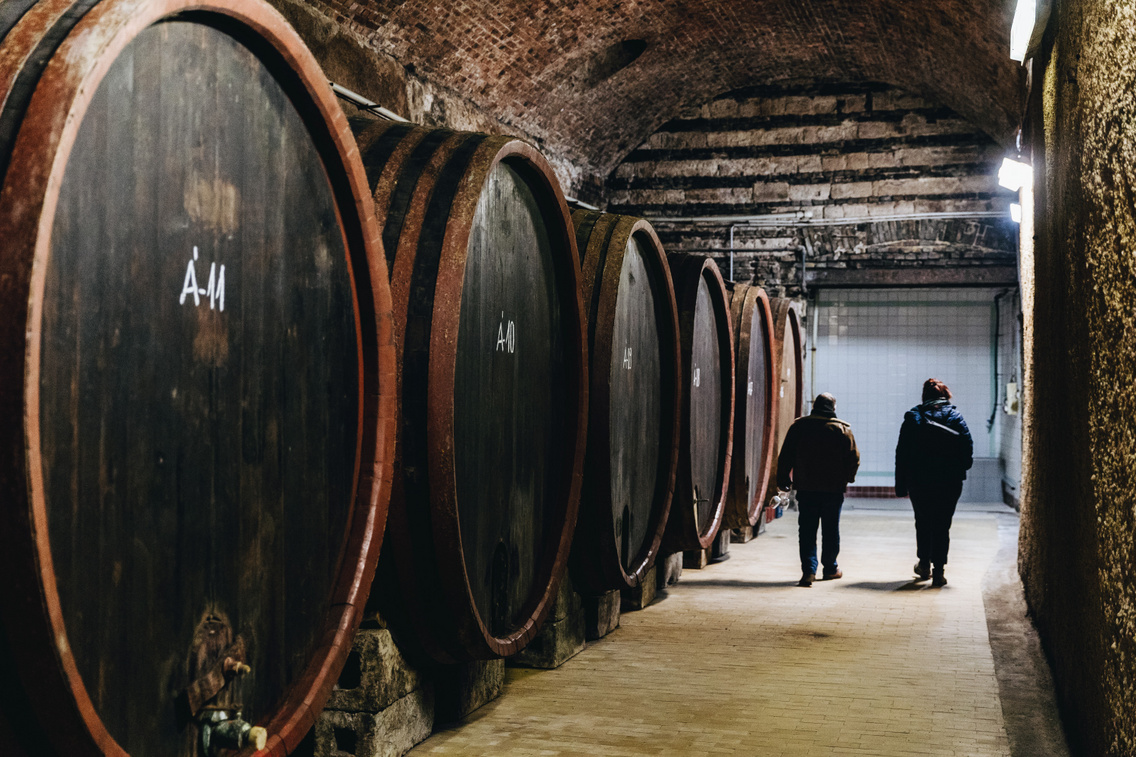
In some sections, visitors need to duck slightly; elsewhere, the monumental spaces with ceilings up to 20 metres high are simply mesmerising. It’s hard to imagine the sheer human effort and centuries of work required to carve out these vast chambers by hand. Traces of quarrying are still visible throughout. Like other cellar systems in Kőbánya, this site also included cave dwellings, once home to poorer families. Fazekas József, head of the Óhegy Winery, who guided us through the site, shared that an elderly couple once visited whose grandparents had lived in one of these cellar dwellings - meaning they themselves played in this courtyard as children. It’s reassuring to see that the site hasn’t fallen into neglect but is instead experiencing a new renaissance.


Respecting the heritage of the past while responding to the needs of today
The cellar’s most recent chapter began in 2010, when István Csernák, founder and managing director of Pince Kft., purchased the site. His personal connection ran deep: he completed his professional training here in the 1970s while working for the Budafok State Farm. Both the building and its surroundings were renovated with great sensitivity and respect for tradition. The yellow ceramic road, once covered in concrete, was uncovered, cleaned and preserved in its original form, as it forms an integral part of the site’s atmosphere.


The building - already standing during the Popper era - was enhanced with decorative ceramic elements created by Berill-Épületkerámia Kft. The ceramic grape clusters quickly became favourites and fit seamlessly into the concept. It’s clear that everything here was done with genuine care, aiming to give the building the recognition it deserves while preserving its historical layers. István Csernák sadly passed away last year, but he left the winery in good hands. He asked his long-time friend József Fazekas - a multi-award-winning winemaker - to support his family with his expertise.

The main building, now home to offices and meeting rooms, the cellar system where past and present coexist, and the reception building near the entrance - where tastings take place - have all been carefully renovated and maintained, each with its own distinctive atmosphere.


A sip of the Balaton at Óhegy
How does Lake Balaton connect to Kőbánya? Through wine, of course. Around 99% of the grapes used here come from the southern shore of the Balaton. The Óhegy Winery’s processing facility is located in Szólád, where grapes from the region are handled. This connection is also deeply personal: István Csernák grew up in Kötcse and attended school in Balatonboglár.


Their best-known range, Balaton Art, offers excellent value-for-money wines across red, white and rosé styles. For more festive occasions, the Vadász Selection features carefully curated, long-aged wines with elegant labels. These bottles are available in major retail chains, while more exclusive selections can be found

Wine tastings not only for wine lovers
The Óhegy Winery can only be visited by prior arrangement. Guests can either join announced programmes or book visits for smaller or larger groups of friends, families or colleagues, from 8 up to 40 people — the maximum number that can comfortably fit in the reception building designed specifically for wine tastings. Fixed-date tastings are also available for individual visitors, and are held every second Friday.


The programme begins in a cosy room with a brief historical introduction, which serves as a perfect lead-in to the approximately 30-minute cellar tour that follows - where tasting glasses soon come into play.
We don’t want to host too many visitors at once, as smaller groups allow us to preserve the personal atmosphere of the experience. Once a group of friends - even 8–10 people - comes together, they can already book a visit, and we’re happy to welcome guests both on weekdays and at weekends,”
– says József, when we ask whether the venue is opened to larger-scale events.


Back in the reception building, guests are treated to guided wine tastings accompanied by a selection of wine snacks and even a wine-themed quiz. The venue is also suitable for corporate events, training sessions, business breakfasts and dinners, as well as team-building programmes. The experience is undoubtedly memorable: the welcome is warm and personal, the stories shared are engaging, and visitors gain a deeper understanding of both the area’s past and the wines produced here. Countless hidden treasures still lie both underground and above ground, ensuring there’s always something new to discover.
You can also book wine tastings online here.
We would like to thank József Fazekas, head of the winery, for the fascinating guided tour.
(Cover photo: Molnár Kata – We Love Budapest)
CONTACT DETAILS
Óhegy Pince

Megjelent első bookazine-unk, ne maradj le róla!
Már 15 éve lélegzünk összhangban a fővárossal. Jubileumi kiadványunkban mindent megtalálsz, ami magazinunk és eddigi munkánk esszenciája. Gasztronómia, kultúra, városi legendák és Budapest arcai, interjúk, történetek és a legjobb helyek – úgy, ahogyan mi látjuk a fővárost.
Rendeld meg itt vagy keresd a nagyobb könyvesboltokban!
hirdetés


